

Rehabilitation Equipment for Clinics That Performs

A clinic can have highly qualified practitioners and still lose valuable treatment time to equipment that is difficult to adjust, unstable under load, or poorly suited to the room. The right rehabilitation equipment for clinics supports a more controlled workflow: patients can transition comfortably, practitioners can position equipment quickly, and every station can serve a defined purpose.
For physiotherapy practices, recovery centers, wellness facilities, and hospitality wellness environments, equipment selection is not simply about filling a room with machines. It is about creating an environment that accommodates different mobility levels, training stages, body sizes, and practitioner-led protocols while maintaining a professional standard of durability and finish.
Start With the Clinical Workflow, Not the Product List
A commercial cardio machine or strength station may look impressive on a floor plan, but its value depends on how it fits into daily appointments. Before comparing models, map the path a patient and practitioner take through the space. Consider arrivals, assessment areas, table-based work, active exercise zones, recovery stations, and exits. This helps identify where open circulation space matters more than another machine.
A compact clinic may benefit from adjustable, multi-use equipment that changes function without requiring constant rearrangement. A larger facility with multiple practitioners may prioritize dedicated stations to reduce waiting and setup time. Neither approach is automatically better. The correct mix depends on appointment volume, available supervision, and the type of programs the clinic delivers.
Equipment should also match the level of assistance expected during use. A treadmill intended for independently active users has different access, handrail, speed-control, and stability requirements than one selected for closely supervised walking work. Likewise, a cable system designed for general fitness is not always the best choice for a clinic that needs highly incremental resistance adjustments and precise starting positions.
Core Rehabilitation Equipment for Clinics
A well-planned equipment package typically combines treatment tables, progressive movement tools, cardiovascular equipment, and recovery-focused accessories. The goal is not to purchase every category. It is to select reliable tools that work together and can be adjusted without disrupting the session.
Treatment Tables and Positioning Equipment
Treatment tables are a foundational purchase because they are used across assessments, manual work, mobility drills, and supported exercise. Look beyond upholstery color and overall appearance. Height range, lifting capacity, table width, frame stability, section configuration, caster design, and ease of cleaning all influence day-to-day usability.
Electric hi-lo tables can be particularly useful where practitioners regularly work with clients who need a lower transfer height or where table height changes frequently between appointments. A stable base reduces unwanted movement during positioning, while adjustable head and back sections can improve setup options. In a high-volume setting, smooth and dependable adjustment mechanisms matter as much as the table's rated capacity.
Low-Impact Cardio Equipment
Cardio equipment for a rehabilitation environment should provide predictable motion, manageable entry and exit, and clear control access. Recumbent bikes, upright bikes, treadmills, cross trainers, and upper-body ergometers can all have a place, but their applications differ.
Recumbent bikes offer supported seating and straightforward adjustments, making them a practical option where comfort and accessibility are priorities. Treadmills require careful comparison of deck dimensions, handrail design, speed range, motor performance, and console simplicity. A wide running surface and secure side rails may be more useful in a clinic setting than entertainment features.
For facilities that require a lower-impact stepping pattern, cross trainers can add variety without the repeated impact associated with running. The frame footprint, pedal spacing, stride design, and transport access should be reviewed before purchase. Small specification differences can have a meaningful effect on whether a machine suits the people using it and the room housing it.
Adjustable Strength and Functional Training Stations
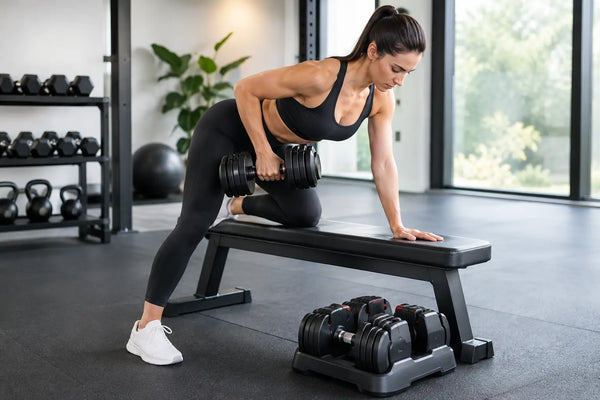
Strength work in a clinic often calls for controlled resistance, multiple angles, and practical adjustment rather than maximum loading alone. Cable machines, functional trainers, selectorized stations, benches, wall-mounted systems, and carefully chosen free weights can create a versatile training zone.
A dual-adjustable pulley system gives practitioners a broad range of movement options from a compact footprint. Key details include pulley height range, resistance increments, cable travel, adjustment handle design, overall machine dimensions, and required clearance around the unit. For clinics serving a wide range of users, small weight increments can be more useful than a high maximum stack.
Adjustable benches need stable bases, secure back-pad positions, durable upholstery, and wheels or handles that make repositioning simple. Storage is equally important. Dumbbells, medicine balls, bands, and smaller accessories should have dedicated racks so the floor remains clear and equipment is immediately available when needed.
Balance, Mobility, and Controlled Movement Tools
Smaller equipment often does a significant amount of work in a clinical setting. Steps, balance pads, resistance bands, Pilates accessories, mats, foam rollers, stability balls, and light training tools support a broad range of guided movement sessions without consuming much floor space.
The trade-off is organization. A collection of small tools can quickly make a premium clinic look crowded if it lacks a storage plan. Choose commercial-grade racks and cabinets that keep equipment visible, accessible, and easy to return after use. This is a functional decision as well as a presentation decision.
Specifications That Deserve Close Attention
When evaluating equipment, compare the specifications that affect operations instead of relying on a generic commercial label. Load capacity should suit the anticipated user population with an appropriate margin. Dimensions should include not only the product footprint, but also access paths, practitioner working room, and service clearance.
Resistance design matters. Pin-selected weight stacks are quick to adjust, while plate-loaded systems offer flexibility but may require more handling and supervision. Magnetic resistance on bikes and cross trainers can provide quiet, smooth changes, whereas air resistance responds directly to user effort. The better choice depends on the intended use, not on a single feature being universally superior.
Durability is also more than frame thickness. Ask about upholstery wear, cable construction, pulley protection, bearing quality, adjustment-point engineering, replacement-part availability, and warranty terms. Equipment that is easy to service helps protect clinic scheduling and long-term operating costs.
Plan the Room Around Access and Supervision
A good layout gives practitioners clear sightlines and gives users enough room to move without feeling exposed or crowded. Avoid placing large machines so close together that a practitioner cannot assist from either side. Keep frequently used tools within reach of the stations where they are needed, rather than storing every accessory at the opposite end of the room.
For new facilities, a 2D or 3D layout can reveal conflicts that are easy to miss when products are selected individually. Door swings, columns, windows, electrical locations, floor transitions, and equipment delivery paths should all be considered before finalizing an order. This is particularly valuable for clinics within mixed-use developments, hotels, and premium wellness centers where the room must perform well without compromising the overall environment.
Aesthetic consistency also has practical value. Coordinated finishes, clean storage, and thoughtfully spaced equipment reinforce confidence and make the space easier to navigate. Premium design should not replace function, but it can support a calmer, more professional experience for clients and staff.
Build a Package That Can Evolve
The best first purchase is rarely the biggest package. Start with equipment that supports the services your clinic already provides, then leave enough room and budget flexibility for future additions. A treatment table, accessible cardio option, adjustable cable station, bench, and organized mobility toolkit can establish a capable foundation without forcing the space into a fixed model too early.
For commercial buyers, 1 REP MAX Fitness can help translate product specifications into a coordinated equipment plan, with delivery, assembly, and after-sales support for high-consideration facility projects. The most effective clinic floor is not defined by the number of machines it contains. It is defined by how confidently each piece earns its place in every session.
Commercial Spin Bikes for High-Use FacilitiesNext →
Gym Equipment Layout Design That Performs