

Does Red Light Therapy Help Muscle Recovery?
The hard session is over, but the next 24 to 48 hours decide whether your training plan stays on track. Delayed soreness, heavy legs, and reduced range of motion can make the following workout feel less productive. Red light therapy muscle recovery has become a popular addition to premium home gyms, performance facilities, and wellness spaces because it offers a low-effort way to support a more deliberate recovery routine.
It is not a replacement for sound programming, sufficient sleep, protein intake, hydration, or appropriate rest. It is a recovery modality that may complement those fundamentals. The difference matters, particularly for athletes and facility operators making considered decisions about space, equipment quality, and member experience.
What Red Light Therapy Is Doing
Red light therapy, often called photobiomodulation, uses specific wavelengths of visible red and near-infrared light. Red light commonly falls around 630 to 660 nanometers, while near-infrared light often sits around 810 to 850 nanometers. Near-infrared light is invisible to the eye and is generally selected for applications involving deeper tissues, including larger muscle groups.
When used at an appropriate dose, this light is thought to interact with cellular processes involved in energy production and local circulation. For a training-focused user, the practical goal is straightforward: support the conditions that help the body manage post-exercise stress and return to normal training capacity.
The research is encouraging, but it is not a blank check. Results can vary with the wavelength, output, distance from the panel, session duration, training status, and the type of exercise performed. A panel that is well built but used inconsistently or at the wrong distance will not deliver the same experience as a properly planned protocol.
Red Light Therapy Muscle Recovery: Where It Fits
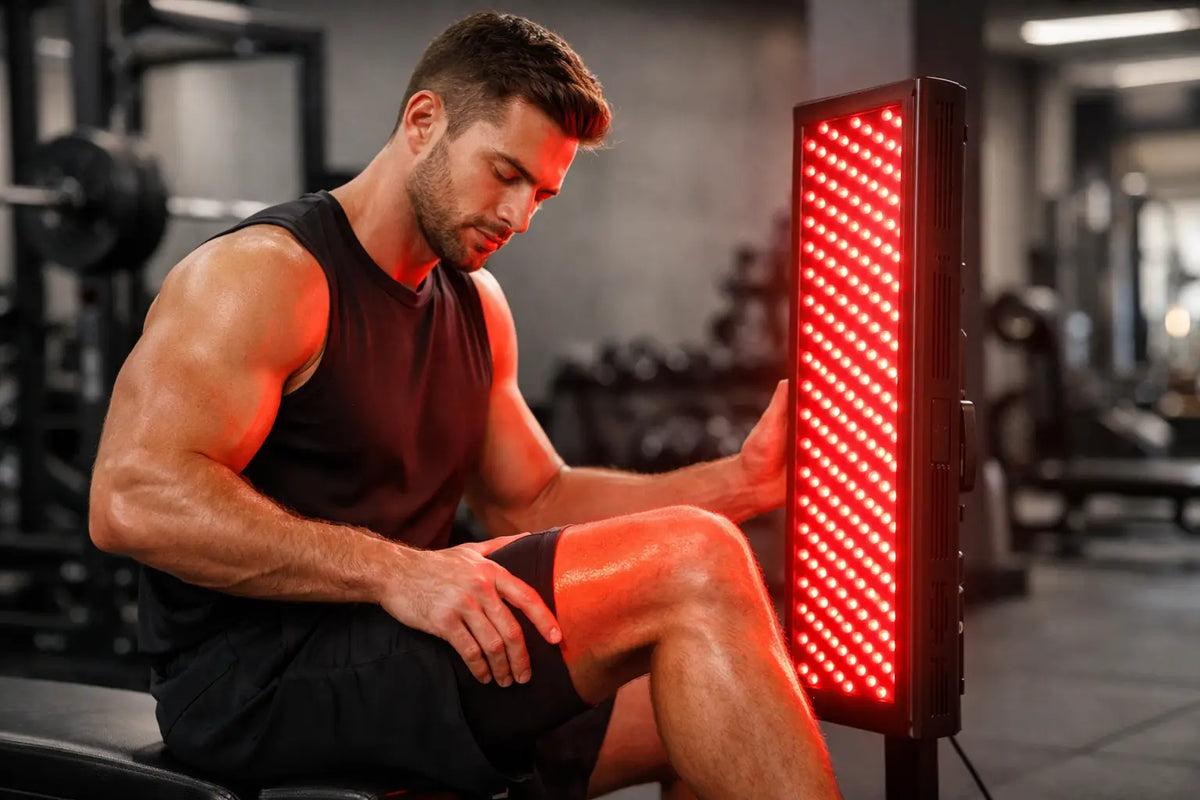
Red light therapy is most useful when it is treated as part of a recovery system, rather than a standalone solution. After demanding strength work, interval training, endurance sessions, or high-volume sport practice, users may choose to expose the most worked areas, such as the quads, hamstrings, glutes, back, shoulders, or calves.
Some people use it shortly after training because it is easy to build into the end of a session. Others prefer an evening session as part of a wind-down routine. Neither approach is universally superior. The better option is the one that fits your schedule consistently without compromising sleep, food intake, or the mobility work you actually need.
For a commercial gym, recovery studio, hotel wellness center, or longevity clinic, a red light panel can add a premium, self-directed recovery station without requiring users to change clothes, shower, or book a long appointment. It can work especially well near stretching space, massage tools, hydrotherapy, or a quieter cooldown area. The operational detail is important: allow enough room for safe standing positions, clear user instructions, ventilation, and a suitable electrical installation completed by qualified professionals.
What It May Help With, and What It Will Not Fix
A sensible expectation is that red light therapy may help support perceived readiness and comfort after training, especially when combined with an intelligent workload. Many users value it because sessions are quiet, noninvasive, and easy to repeat at home or in a facility.
It cannot compensate for a program that exceeds your current capacity. If your squat volume has doubled, your running mileage has jumped sharply, or your sleep has been poor for weeks, a light session does not erase those inputs. Likewise, persistent pain, substantial swelling, weakness, or loss of function deserves assessment from a qualified health professional rather than a recovery-device experiment.
Recovery tools also involve trade-offs. A compact panel can be practical for a home gym and targeted use, but covering the entire lower body will take repositioning. A larger full-body panel improves coverage and workflow, which can be valuable in a high-use wellness environment, but requires more floor or wall space and a larger investment. The right choice depends on whether the priority is individual training, shared household use, or repeated member access.
How to Use a Panel More Effectively
Follow the device manufacturer’s instructions first. Output, recommended distance, session duration, eye-protection guidance, and use frequency differ between products. More time is not automatically better. Light therapy follows a dose-response pattern, so excessive exposure may be less useful than a measured, repeatable protocol.
Start by selecting the muscle groups that received the greatest training load. After a lower-body strength session, that may mean the front and back of the thighs, glutes, and calves. After upper-body pulling work, focus on the lats, upper back, rear shoulders, and arms. Position the exposed skin at the manufacturer-recommended distance, keep the panel unobstructed, and move methodically if one panel does not cover the entire area.
Consistency matters more than chasing perfect timing. A short session several times per week can be easier to sustain than an ambitious protocol used once and forgotten. Track your training volume, soreness, sleep quality, and perceived readiness for several weeks. This gives you a more useful signal than judging the device after a single difficult workout.
Avoid treating the panel like a screen. Do not stare directly into bright LEDs, and use any eye protection recommended by the manufacturer. People who are pregnant, have light sensitivity, use medications that can increase photosensitivity, or have a specific medical concern should check with an appropriate clinician before use.
Choosing a Red Light Panel for a Home Gym or Facility
Specifications matter more than marketing language. A premium panel should clearly state its wavelengths, irradiance or power output at a stated distance, treatment area, dimensions, electrical requirements, control options, and warranty coverage. If those details are difficult to find, it is difficult to compare one system with another.
For most buyers, the decision comes down to coverage, placement, and throughput. A targeted panel suits users who want to focus on particular areas after lifting, cycling, running, or Pilates. A larger panel is more efficient for full-body exposure and for environments where multiple people will use it throughout the day. Consider whether it will be wall mounted, placed on a mobile stand, or installed in a dedicated recovery room. A mobile configuration can make sense in a multi-use studio, while a fixed setup creates a cleaner experience in a planned wellness zone.
Controls deserve attention as well. Simple timed sessions reduce user error in shared spaces. Adjustable intensity and independent red or near-infrared settings can give experienced users more control, but only if the interface remains clear. For commercial applications, durable finishes, stable mounting hardware, manufacturer support, and a straightforward cleaning process are as important as the light specifications themselves.
At 1 REP MAX Fitness, recovery equipment is best evaluated in the same way as a rack, treadmill, or commercial bike: by fit for purpose, engineering details, daily usability, and long-term reliability. A recovery zone should feel considered, not added as an afterthought.
Keep the Foundations in the Plan
The most effective recovery routine is usually not the most complicated one. Build the basics first: progressive training loads, enough calories and protein for your goals, adequate fluids, regular sleep, and planned lower-intensity days. Add easy movement, mobility, foam rolling, massage, compression, hydrotherapy, or red light therapy when they help you feel ready to train well again.
Red light therapy earns its place when it makes recovery easier to practice consistently. Choose a panel with transparent specifications, use it according to its guidance, and judge it by how well it fits your complete training environment. The goal is not to eliminate every sensation after hard work. It is to build a routine that lets you return to the next session prepared, capable, and confident.
Hydrotherapy Bed Recovery Benefits ExplainedNext →
How to Choose a Commercial Treadmill Supplier