

How to Choose an Elliptical for Bad Knees
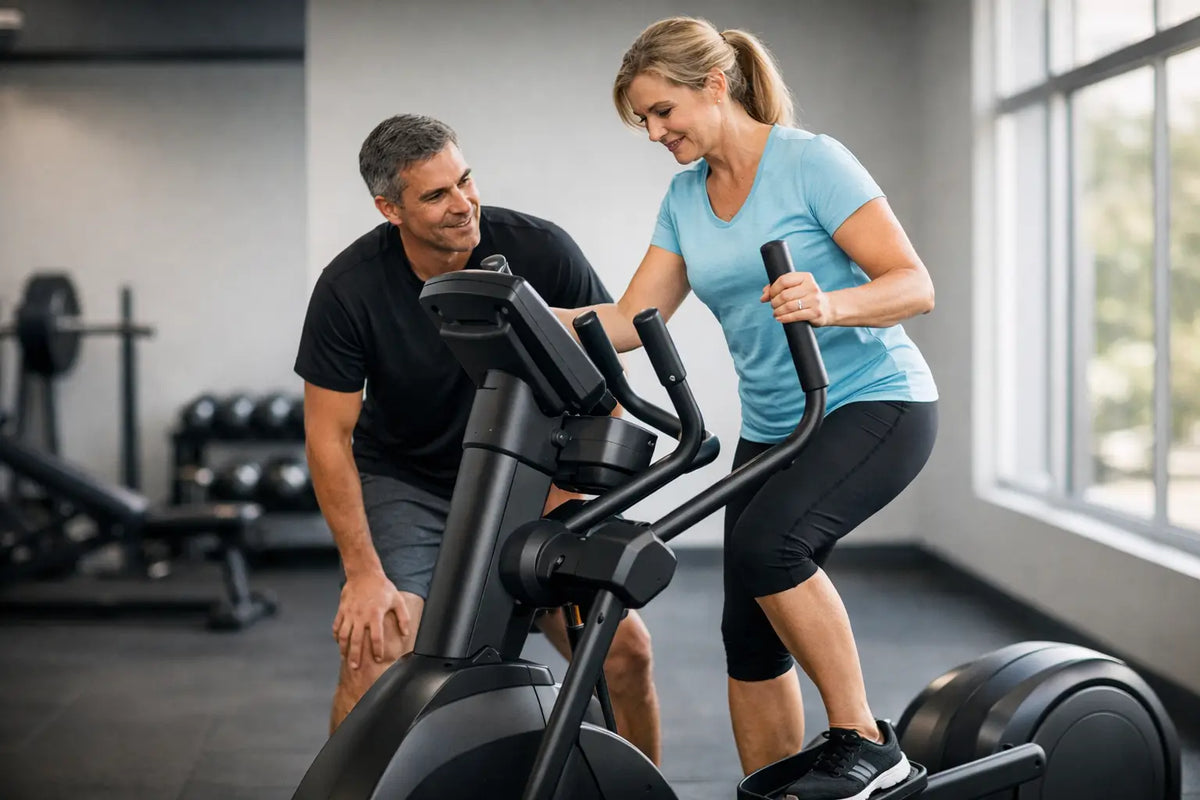
A cardio machine should not make every workout feel like a negotiation with your joints. The right elliptical for bad knees keeps your feet supported through the full motion, removes the repeated landing impact of running, and lets you build effort gradually. But not every cross trainer feels equally comfortable. Stride design, pedal spacing, resistance delivery, frame stability, and setup all affect how the workout feels from the first minute to the last.
For a home gym, wellness space, or commercial facility, the aim is not simply to find a machine labeled low impact. It is to choose one with movement mechanics that suit the person using it and the training volume expected of it.
Why an Elliptical Can Be a Smart Low-Impact Option
An elliptical guides the feet in a continuous oval path rather than asking them to strike a moving deck or the ground on every step. That supported motion can make it a practical cardio option for people who find running, jumping, or high-volume walking uncomfortable for their knees.
The benefit is not that an elliptical eliminates all knee loading. Your knees still bend, extend, and manage force as you pedal. The difference is that the feet remain in contact with the pedals, which reduces repetitive impact. Resistance can also be changed in small increments, allowing a controlled approach to conditioning rather than forcing a fixed pace or terrain.
This makes ellipticals useful across a wide range of training goals: steady aerobic sessions, warm-ups before strength work, lower-impact conditioning days, and general daily movement. For facilities, they are also a valuable choice because members with different experience levels can usually understand the movement quickly.
Comfort remains individual. A machine that feels fluid and natural for one user may feel too short, too wide, or too aggressive for another. Whenever possible, test the motion at an easy pace before focusing on screen features or preset programs.
What Makes an Elliptical for Bad Knees Feel Better
A stride length that matches the user
Stride length is one of the first specifications to check. If the stride is too short for a taller user, the movement can feel cramped, with excessive knee flexion at the front of the pedal path. If it is too long for a smaller user, it can feel like reaching with every step.
Many home ellipticals use a fixed stride, while premium models may offer a longer stride or adjustable stride settings. For multi-user homes, hotels, and commercial gyms, adjustability can be worth prioritizing because it accommodates a wider range of body sizes and training styles. A natural, unforced stride is generally the better choice than simply selecting the longest specification available.
Pedals that support a natural foot position
Look closely at pedal size, surface grip, and spacing. Oversized pedals provide more room to find a stable stance, while textured surfaces help limit unwanted foot movement during harder efforts. Pedal spacing, sometimes called the Q-factor, matters as well. A very wide stance may feel awkward for some users and can change lower-body alignment throughout the stride.
Some ellipticals use articulating pedals that adjust with the movement of the foot. This feature can reduce the sensation of being locked into one angle, particularly during longer sessions. It is not essential for everyone, but it is a worthwhile feature to compare when knee comfort is the main purchase priority.
Smooth resistance without sudden surges
A smooth resistance system helps you maintain rhythm. Magnetic resistance is valued for quiet operation and precise intensity changes, while electromagnetic systems on higher-spec machines can provide broad resistance ranges and accurate program control. The key is consistency: the pedals should not lurch, stick, or feel dramatically heavier at one point in the rotation.
A heavier flywheel can contribute to a more stable pedaling sensation, although flywheel weight alone does not define ride quality. The drive system, gearing, frame, and overall engineering work together. For a premium purchase, judge the complete feel of the machine rather than relying on one specification.
A stable frame and secure contact points
Knee-friendly training also depends on confidence. A frame that rocks on the floor, pedals that flex, or handles that feel loose can encourage a tense, guarded movement pattern. Choose an elliptical with a sturdy base, a user capacity appropriate for the intended users, and a level placement area.
Fixed handlebars are especially helpful when balance or stability is a concern. Moving handlebars add upper-body involvement, but users should be able to lightly hold the stationary grips when they want to focus on lower-body control. Commercial-grade frames and components are particularly worthwhile in shared spaces where the machine will see frequent daily use.
Front Drive, Rear Drive, or Center Drive?
Drive placement changes the character of the motion, though there is no universal winner for every knee or every room.
Front-drive ellipticals are often space-efficient and can provide a climbing-style feel. Depending on the model, the motion may involve more forward body positioning. They are common in residential settings, but users should test whether the pedal path feels smooth at their preferred pace.
Rear-drive ellipticals often create a longer, flatter stride that some people find more natural for steady cardio. Their footprint can be longer, so measure the intended space carefully, including clearance around the pedals and access to the machine.
Center-drive models place the user between the drive components and can offer a compact footprint with a more upright motion. They can be a strong option where floor space is limited, but the best choice still comes down to stride comfort, stability, and build quality.
Rather than choosing based on drive type alone, compare the real movement: Can you stand tall? Do your knees track comfortably through the pedal path? Can you sustain an easy pace without gripping the handles or shifting your feet? Those answers matter more than a label.
Features Worth Paying For
The most useful features are the ones that support consistent training. Adjustable resistance with enough range for progress is essential. A clear console helps users monitor time, pace, distance, and effort without distracting from technique. Heart-rate compatibility can be valuable for structured aerobic work, provided the readings are used as guidance rather than as the only measure of effort.
Incline is more nuanced. It can add variety and engage the posterior chain, but it also changes joint angles and workload. A power incline feature is useful when it is introduced gradually, not because it automatically makes a machine better for every user. If knee comfort is the priority, begin with a level or modest incline setting and learn how the body responds.
For residential buyers, consider transport wheels, power requirements, ceiling height, machine dimensions, and service access. For commercial projects, evaluate duty rating, component durability, warranty terms, console management, and the availability of local delivery, assembly, and after-sales support. These details determine whether an elliptical remains a reliable part of the training environment over time.
Set Up the Workout for Knee Comfort
Even an excellent machine can feel wrong when the setup is rushed. Start by placing the elliptical on a firm, level surface. Confirm that it does not rock before use, and wear supportive training shoes that sit securely on the pedals.
Begin at a light resistance and an easy, controlled cadence. Keep the torso tall, shoulders relaxed, and feet planted fully rather than pushing through the toes. Let the knees travel in line with the feet instead of allowing them to collapse inward. Avoid forcing a deep squat-like position or chasing a high incline before the movement feels established.
Duration should build progressively. A comfortable 10- to 15-minute session performed consistently is more useful than one punishing workout followed by several missed days. As fitness improves, increase one variable at a time: a few more minutes, a small resistance increase, or a modest pace change. This approach makes it easier to identify what feels productive and what feels like too much.
If knee discomfort is new, persistent, sharp, or worsening, stop the session and seek individualized guidance from a qualified health professional. Equipment can support low-impact exercise, but it should not be used to train through pain.
Questions to Ask Before You Buy
Before selecting an elliptical, ask who will use it, how often it will be used, and where it will sit. A compact model may suit an apartment gym with one primary user, while a villa gym or corporate wellness room may need a heavier-duty machine with a broader stride range and higher user capacity.
Also ask whether the buyer needs a quiet machine for early-morning training, a touchscreen console for guided workouts, or straightforward controls for a high-traffic facility. These preferences shape value. The best model is not necessarily the one with the most programs. It is the one whose mechanics, capacity, footprint, and service requirements match the space and the people training in it.
At 1 REP MAX Fitness, a well-chosen elliptical is part of a complete training environment, not a compromise cardio option. Give priority to smooth movement, stable construction, and settings you will actually use. When the machine feels secure and natural, it becomes far easier to return to it tomorrow.
Best Rowing Machine for Small Apartment SpacesNext →
Choosing a Power Rack for Garage Gym Training